When the Search Becomes the Job
Nobody warns you about month four. The search is the job: unpaid, rejection-heavy, and real.
Nobody warns you about month four.
Month one, people are kind. They check in. They offer to connect you with someone they know. They send you job postings that are wildly off-base but mean well. There is a general sense among your circle that this is a temporary situation, a minor disruption, and that someone with your experience will land quickly.
Month two, the check-ins start to thin. People assume no news is good news, or they feel awkward asking again. You are still optimistic in a grim sort of way. You have a system. You are tracking your applications. You have had a few first interviews, maybe a second one. You are telling yourself the pipeline is building.
Month three, something shifts. The pipeline that was "building" has mostly gone quiet. The companies that seemed interested have either ghosted you, filled the role with someone else, or are somehow still "in the final stages of evaluation." You are applying to things you would not have looked at in month one. You are starting to wonder if you're doing something wrong. You're not. The market is just that slow.
By month four, you have stopped telling people you are looking unless they ask directly. Because the conversation has a script now, and you are tired of performing it.
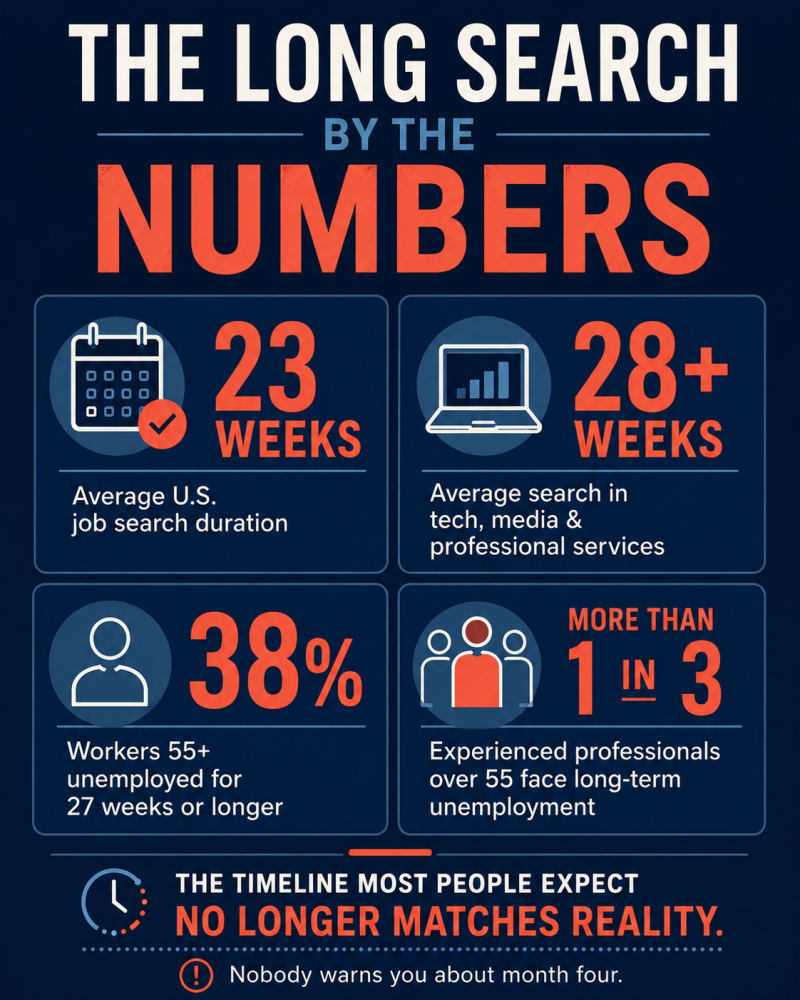
Here is what the data says, for those of us who find numbers grounding in the absence of control: the average job search in the U.S. currently runs close to 23 weeks. That is nearly six months. For workers in tech, media, and professional services, the mean stretches past 28 weeks. And for workers over 50, the picture is bleaker still: we are disproportionately represented in the long-term unemployed category, defined as 27 weeks or more without work. In May 2026, nearly 38 percent of job seekers 55 and older fell into that category, compared to about 27 percent of younger workers.
Read that again. More than one in three experienced workers over 55 is searching for six months or longer.
This is not a personal failing. It is a structural reality. It is also something almost nobody talks about, because the conversation about job searching still operates on an assumed timeline that stopped being accurate years ago.
The thing that does not get discussed enough is what a long search does to your sense of self.
In the first few weeks, you are still your job title. You introduce yourself the way you always have, with the assumption that the past tense is temporary. But somewhere around month three or four, that identity starts to feel borrowed. You catch yourself hesitating before you explain what you do, because what you do and what you are doing have become different things.
You start to fill the gap with productivity theater. More certifications. More content. More outreach. Not because any of it is necessarily moving the needle, but because doing nothing feels like admitting something you are not ready to admit. The structure of the search becomes a substitute for the structure the job used to provide.
And underneath all of it, quiet and persistent, is the shame.
Not the loud, dramatic kind. The low-grade kind. The kind that makes you slightly dread the question at a dinner party or a family gathering. The kind that makes you hesitate before posting on LinkedIn, because what exactly do you post at month five that does not sound like desperation or performance? The kind that makes you recalibrate your own worth in ways you would never apply to anyone else in your situation.
You would not look at a colleague going through a long search and conclude they were failing. But you will do exactly that to yourself, regularly, without noticing you are doing it.
The social dimension of a long search deserves its own honest accounting.
Your inner circle, the people who genuinely care about you, will mostly stay in your corner. But even they have limits. Not because they stop caring, but because they run out of things useful to say. "Something will come through" starts to feel hollow to both of you. The conversations shift from support to small talk, not out of cruelty but out of exhaustion. They want you to be okay. Sometimes it is easier for everyone if you perform okay.
The wider network is a different story. People who offered to help in week two have mostly moved on. Not maliciously. Life moved on for them. Following up on month-old coffee offers starts to feel like asking someone to remember a promise made at a party. Some people come through anyway. Others do not, and you learn to stop being surprised by that.
What you are left with, often, is a smaller but more honest circle. That is worth something, even if it does not feel like it at the time.
There is a specific conversation that happens in long searches that I want to name, because I have had it and I suspect you have too.
It is the conversation with yourself about lowering the bar.
Not your standards, exactly. Your scope. The roles you apply to, the salary ranges you will consider, the company sizes, the titles. Everything that felt like a reasonable floor in month one starts to look like stubbornness by month five. And there is genuine wisdom in some of that recalibration. Markets are not always fair, and sometimes the path forward is not the one you planned.
But there is a difference between strategic flexibility and searching from panic. The former is useful. The latter tends to land you in a role you will leave in eight months, which resets the clock and costs you more time than holding the line would have.
The question worth sitting with is not "should I lower my expectations?" The better question is "which expectations are protecting me, and which ones are protecting my ego?"
Those are not always the same answer.
If you are in the long search right now, I want to talk to you directly for a moment.
You are not invisible, even though it feels that way. The silence from recruiters is not a verdict on your value. The ATS systems that are filtering your resume before a human ever reads it do not know what you have built or what you know how to do. The companies that went quiet after a second interview are not sending you a message. They are, in most cases, just deeply dysfunctional in ways that have nothing to do with you.
The shame you are carrying is not yours to carry. A hiring market where more than a third of experienced professionals over 55 are searching for six months or more is not a personal problem. It is a systemic one. You did not create it. You are not uniquely failing to escape it.
What you are doing, every day you get up and work the problem, is harder than most employed people will ever understand. The search is the job. It is an unpaid, rejection-heavy, feedback-starved job with no clear timeline and no guarantee. And you are still doing it.
That is not nothing. That is, in fact, quite a lot.
The search will end. It ends differently for different people, on different timelines, in different ways than planned. But it ends. Hang in there.