Ghost Jobs: You Weren't Failing. You Were Applying to Nothing.
A ghost job is a posting nobody intends to fill. The silence you blamed yourself for was often the design.
There is a particular kind of quiet that settles in around month three of a search. You have refined the resume. You have tailored the cover letters that nobody reads. You have applied, cleanly and on time, to roles you were genuinely built for. And you have heard nothing. Not a rejection. Not an auto-reply with a pulse. Nothing.
For a long time I did what most of us do with that silence: I turned it inward. Wrong keywords. Too senior. Too expensive. Too something. You run the audit on yourself so many times that self-doubt starts to feel like diligence.
Then I noticed a listing I had applied to in the spring reappear in the summer. Same company, same title, same suspiciously vague description, posted again as if it were brand new. And it clicked. I hadn't lost that job. That job was never there to lose.
Welcome to the ghost job.
The thing has a name now, and the numbers are not small
A ghost job is a posting a company has no current intention of filling. It sits on the board looking like opportunity, and it is functionally set decoration.
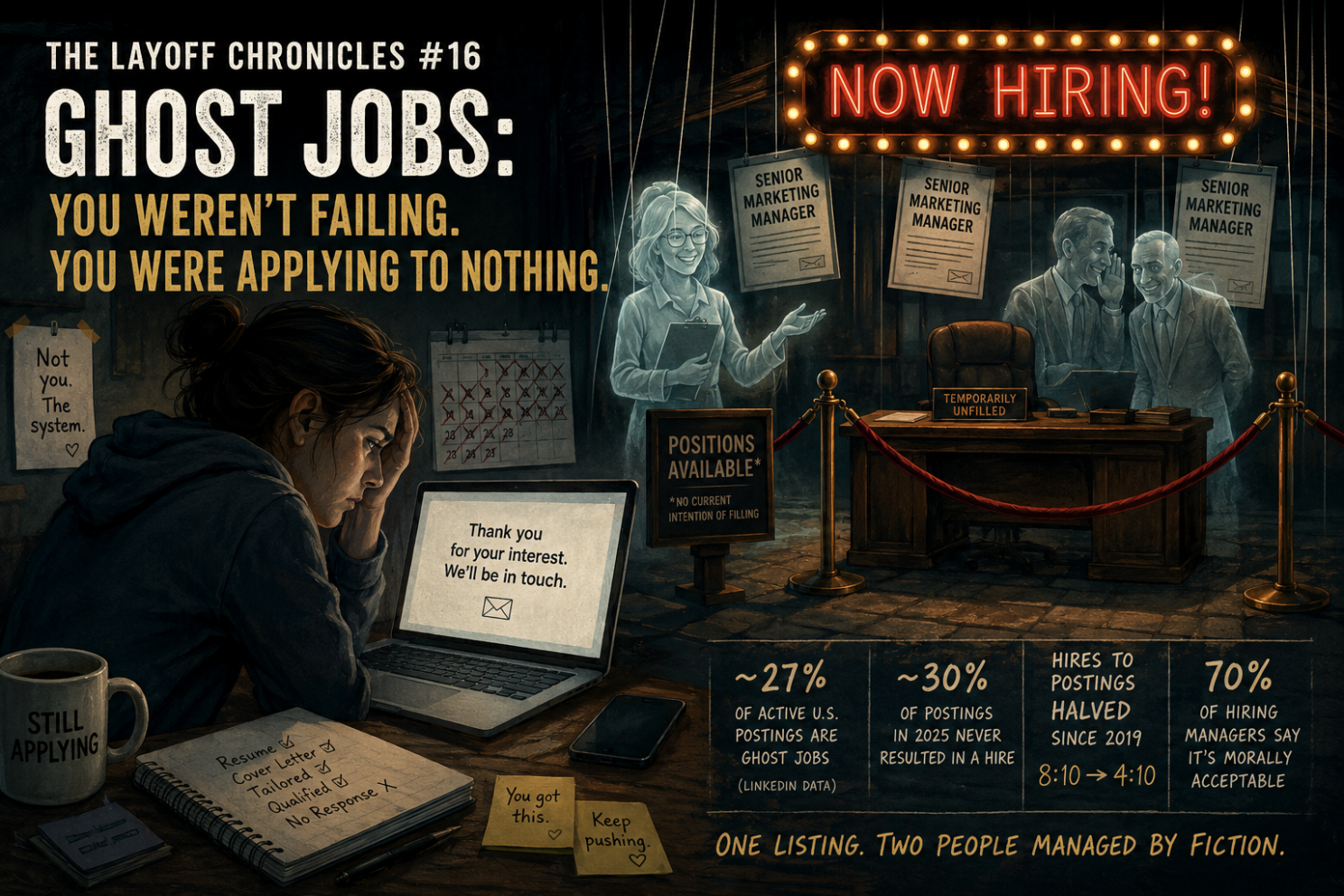
The estimates vary by who is counting and how, and I want to be honest about that range rather than pick the scariest number and run. Some analyses put ghost jobs at around one in seven listings. An analysis of LinkedIn data pegs it closer to 27 percent of active U.S. postings. When you measure by outcome instead of intent, the picture gets worse: roughly 30 percent of postings in 2025 never resulted in a hire at all.
The methodology arguments are real. The direction is not in dispute. And here is the stat that reframed my entire spring: the ratio of hires to postings has roughly halved since 2019, from about eight hires for every ten postings to about four. The board doubled in size while the actual hiring stayed flat. You are not imagining that you are working twice as hard for the same result. You are.
They are not embarrassed about it
I could stomach the numbers. What I could not stomach was the honesty in the surveys.
In a Resume Builder survey of hiring managers, 40 percent of companies admitted to posting a fake listing in the past year, and three in ten said they had fake listings up right now. Nearly 60 percent said they collect resumes to keep on file with no intention of hiring anyone immediately. That folder of applications you assumed was going somewhere is, for a lot of you, the somewhere. You applied to a filing cabinet.
The reasons are where it stops being sloppy and starts being deliberate. Employers post ghost jobs to project the image of a growing company. They post them so that overworked staff believe relief is coming. And, in the part I keep re-reading to make sure it says what it says, they post them to make current employees feel replaceable, on the theory that a nervous employee is a productive one.
So the same posting can serve two purposes at once. It keeps you refreshing your inbox at home, and it keeps someone else afraid at their desk. One listing, two people managed by fiction.
Roughly seven in ten hiring managers in that survey said the practice is morally acceptable and good for business. That is not a rogue-recruiter problem. That is the consensus in the room.
The cruelest detail
Here is the one that would be funny if it weren't happening to people I know. Among the companies running fake postings, almost 40 percent said they always contact the applicants anyway. Of those, 85 percent said they interview them.
Sit with that. You get the email. You feel the small lift you have not let yourself feel in weeks. You block the afternoon, you press the shirt, you do the company research, you build the smart questions, you show up as your sharpest self, and you perform for a role that has no chair behind it. The interview was not a step toward a decision. The interview was the product. You were the raw material.
If you have walked out of a conversation that felt warm and went nowhere and could not understand what you did wrong, consider that you may have done nothing wrong, because there was nothing on the other end to get right.
What this does to a person over time
Regular readers know I do not traffic in silver linings, and I am not about to start. So let me name the actual damage, because it is not just wasted afternoons.
The extended search I wrote about last time is already a grind. Ghost jobs add a specific injury on top of it: they corrupt your feedback loop. The whole psychological contract of a job search is that effort and honesty eventually produce signal. You apply, you hear back, you adjust, you improve. Ghost jobs sever that wire. You send real effort into a void designed to look like a door, and the silence that comes back teaches you the wrong lesson about yourself.
That is the part that lingers. Not the lost hour. The slow, quiet conclusion that you are the problem, arrived at through evidence that was manufactured. It is gaslighting at industrial scale, and most of the people caught in it are blaming themselves in the dark.
The system is finally being named
If there is anything solid to stand on here, it is this: the practice is finally being treated as a practice, not a personal failing.
In 2026 the pushback moved from vent posts to statute. New York's Senate passed legislation that would require employers to state whether a posting reflects a current vacancy and to specify an intended fill date. Pennsylvania introduced a Ghost Job Postings Prevention Act that would bar posting roles that do not exist and force employers to disclose how many times a position has been reposted. New Jersey, California, and Kentucky have bills in motion. Pay transparency laws walked so hiring transparency could start running.
None of that lands you a job this quarter. But it matters for a smaller, stubborn reason: it moves the shame off your side of the table. When lawmakers start writing bills about a thing, we stop having to wonder whether the thing is real or whether we are just soft.
What to actually do with this
Not a hustle list. A sanity list.
Track the reposts. If a listing has been up for months or keeps resurfacing unchanged, treat it as scenery, not a lead. Note the date you first saw it.
Weight your energy toward roles with fingerprints. A named hiring manager, a specific team, a reason the job exists this quarter, a recruiter who answers a direct question directly. Vague and evergreen is a signal.
Stop grading yourself on volume. Two hundred applications into a system that is one-quarter fiction is not a measure of your worth or even your effort. It is a measure of the noise. Protect the hours you were burning on the void and put them into the handful of real conversations that actually move.
And when the silence comes, try on a different first explanation than the one you have been using. Before "what is wrong with me," try "was that ever a real job." Often enough now, it wasn't.
You were not failing at applying. A good share of the time, you were applying to nothing. That distinction will not pay your mortgage, but it might give you back the one thing this market is quietly stealing: the accurate story of how hard you are actually working.